
I knew I was really in Ecuador the moment I landed — not because of the scenery, but because of the people. As far as solo travel in Ecuador goes, it started gently.
It was late. The streets were dark. I was tired in that specific, slightly disoriented way that comes from long flights and new continents.
When I arrived, my airport driver graciously coordinated with the hotel staff to make sure I arrived safely. He called the reception, and made sure hotel staff were aware that I would be arriving late. He also walked me to meet said hotel staff to ensure that I wouldn’t be wandering the streets along at night.
When I finally got to the hotel and realized I was starving, the hotel staff didn’t hesitate. They pulled out their personal phones and helped me order food, well past what I’m sure was their official job description. They went above and beyond for someone who literally just arrived.
That kind of care is rare. In the U.S., it’s almost unheard of. Even in Europe, it’s not something you expect. Ecuador welcomed me gently… before it started humbling me.
When Spanish Loads… Slowly
After a gentle start, things went off-script almost immediately.
On my very first tour, I was casually placed into a Spanish-speaking group. To be fair, the tour company did ask if I can speak Spanish. I mean… I do. Just not well enough for a tour.
I guess I bit off more than I can chew. No warning. No buffer. Just vibes.


My brain hadn’t fully switched languages yet, so my Spanish was… loading. Slowly. Buffering. Occasionally crashing. But the tour guide was patient, and I asked questions in my broken, slightly apologetic Spanish. Somehow, it worked.
Here’s video proof that I made friends with fellow travelers despite the language barrier:
Another part of the plan that unraveled involved buses. Specifically: the lack of them.
My travel itinerary was: Quito –Cotopaxi — Banos– Riobamba– Cuenca.
This was my first time doing extended solo travel in Ecuador, and I quickly learned that no itinerary survives reality intact.
From Baños, I was supposed to travel to Cuenca. The bus ride was around eight hours, so I thought I’d be clever and split the trip. I’d stop in Riobamba for a couple of nights, then continue on.
What I failed to account for was a nationwide transport strike.
Why does this always happen when I’m in town? The same thing happened in Portugal. And Italy. And Spain.
I’m starting to think this is a personal curse.
Buses from Riobamba to Cuenca were scarce to nonexistent. So I improvised and decided to head back to Baños, hoping a bigger city would offer better options.
Well, guess who fell asleep and missed her stop?
And that’s how I accidentally ended up in Puyo, deep in the Amazon, instead of Baños.

At 10 a.m., I stood in a bus terminal being told the next bus to Cuenca wouldn’t leave until 8 p.m. Solo travel confidence is great until logistics and safety start having a very loud conversation in your head.
I seriously considered the odds. Here I am, 5 feet and 2 inches, with barely passable Spanish, about to travel on a night bus. My nurse brain wanted safety, but my traveler brain wanted adventure.
So I did what any rational adult would do: I called my Italian teacher, Mirko, who happened to be in Quito.
His advice was simple: You wanna be safe? Come here to Quito.
That detour turned into almost a week in the capital. I missed Cuenca entirely, but I gained something else — time with a friend, new travelers, unexpected conversations, and the reminder that detours aren’t always losses.

Hitchhiking, Cows, and Other Excellent Decisions
Ecuador also reminded me that my misadventures are not always logistical. Sometimes, they’re… agricultural.
In Urbina, I milked a cow.
Midway through the experience, the cow decided to do what cows do. Poop.
The experience was unforgettable.
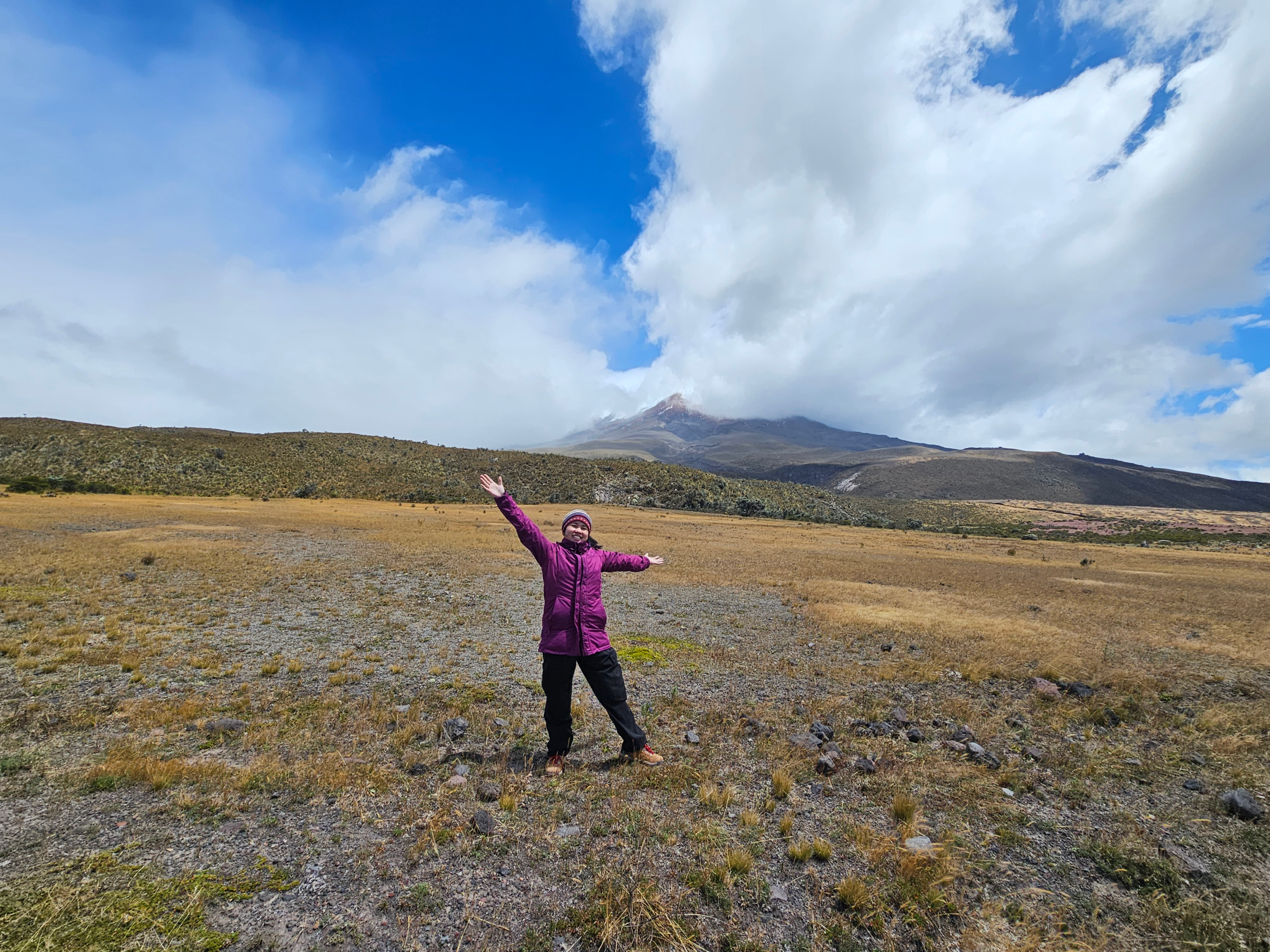
Then there was Cotopaxi.
I wanted to hike around Lake Limpiopungo. The driver kindly offered to drop me off at the lake and told me to hike back to the tourist center when I was done. I thought the walk would be easy.


It was — until it wasn’t.
By the time I finished hiking around the lake, I was tired, hungry, and staring at a very long walk back. I ate my emergency banana and had a quiet moment of reckoning.
Surprisingly, I wasn’t afraid of other humans. I was more afraid of the elements. I weighed my options carefully…
And after three cars passed me by, I decided to hitchhike.
Thankfully, an English-speaking couple stopped and gave me a ride back to the tourist center, restoring my faith in humanity and my blood sugar levels.
Yes. I’m safe. I wouldn’t be able to write this blog post if I had been left to die in the Andes.
Horses, Time, and Learning to Let Go

If Ecuador gave me chaos, it also gave me calm. And it came on horseback.
Time slowed every time I rode.
In Baños, Riobamba, and Cotopaxi, horseback riding became my favorite way to move through the landscape. At first, I tried to control everything. I pulled at the reins near puddles. I worried about hills. I micromanaged.
Eventually, I realized the horses knew better than I did.
They knew when to slow down, when to gallop, how deep the water was, and how to avoid it. All I had to do was trust.

That surprised me: how much I enjoyed it, how grounding it felt, how connected I felt to another living being and the land at the same time.
I wish I had spent more time riding. More time letting the world pass by at a pace that made sense.
What Ecuador Quietly Taught Me
Ecuador taught me honesty.
Not the dramatic kind, but the quiet, necessary kind.
I learned to be honest about what I can and cannot do. I’m not elderly, but I’m not at peak health either. I learned to listen to my body. To stop forcing myself into experiences just because other travelers could do them effortlessly.

No matter how many blogs I read or vlogs I watch, my travel experience will always be mine. Discomfort, limits, and adjustments are part of the deal, and embracing them is part of growing.
Meeting other travelers also stirred something uncomfortable and undeniable.
They felt free.
Sure, I don’t know their whole stories, but in my conversations, I realized how much of my life was dictated by schedules that weren’t mine. By approval I had to ask for. By systems that decided when and how I could live.
Ecuador didn’t introduce that thought — it made me accept it. Finally.
When Thoughts Become Plans
Before Ecuador, I lived with a lot of thoughts.
After Ecuador, those thoughts became plans.
The question “If not now, then when?” stopped being rhetorical. It became a principle.
I didn’t need a grand moment to realize this. The images that linger with me are simple: walking through a city looking for a local restaurant, ordering food, wandering without urgency. Imagining a future where life feels lived instead of scheduled.

All my travel lessons, misadventures, reflections, and questions seemed to converge in Ecuador. It gave me direction without shouting. Purpose without pressure.
And maybe that’s what made it so powerful.
Sometimes, the biggest changes don’t come from perfectly executed plans — they come from getting lost, missing buses, trusting horses, and realizing that life is far too short to keep waiting for the “right” time.
Solo travel in Ecuador reminded me that you don’t always need a plan — just the willingness to pivot, trust, and pay attention.
I don’t know when the next misadventure begins, but I do know this: it’ll come with more intention, more stillness, and probably another horse.
Snapshots of My Ecuador Adventure
Quito and Cotopaxi


Banos and Puyo


Riobamba and Urbina


Quilotoa


Leave a Reply